Quick Answer: The secret to affordable luxury travel hacks is knowing that luxury is a modular experience, not an all-or-nothing lifestyle; by strategically choosing when to pay for space and when to save on fluff, you can feel like a VIP without a Black Card or elite status.
Let’s be honest: the travel industry wants you to believe that the “good life” is reserved for people with Centurion cards or those who spend 200 nights a year in a Marriott. They want you to think that unless you’ve got a “Diamond” or “Platinum” badge next to your name, you’re destined for the middle seat next to a guy eating a tuna melt.
We don’t buy into that (well, not always). We’re big fans of the Occasional Splurger, the traveler who works hard, travels specifically, and wants their vacation to feel like a reward, not an endurance test. You don’t need to be a points-and-miles monk to get the good stuff. You just need to know how to play the “Splurge Math” game and use a few affordable luxury travel hacks that actually move the needle.
The 6-Hour Rule: The Line Between Comfort and Chaos
The most common internal debate at the check-in kiosk is: Is that Premium Economy upgrade worth it? You’re staring at a $200 price tag for a little extra legroom and a better meal.
We use The 6-Hour Rule: if your flight is 6+ hours, Premium Economy is usually worth pricing out; under 4 hours, it’s usually not. Your knees can handle a four-hour hop to Cancun. But once you cross that six-hour threshold—most transatlantic and transcon routes—the physical toll on your body changes.
And here’s the part people miss: the buy-up market is getting bigger. According to Delta’s November 2024 investor data, 70% of premium cabin bookings are now paid rather than upgraded — meaning the buy-up market is real and growing.
Upgrading to Premium Economy on a 7-hour flight isn’t just about legroom; it’s about the “deplaning energy.” With extra recline and space, you don’t spend the first 24 hours of your trip recovering from a cramped back. It’s one of the smartest moves you can make because it bridges the gap between the “canned sardine” experience and the “five-figure price tag” of Business Class.
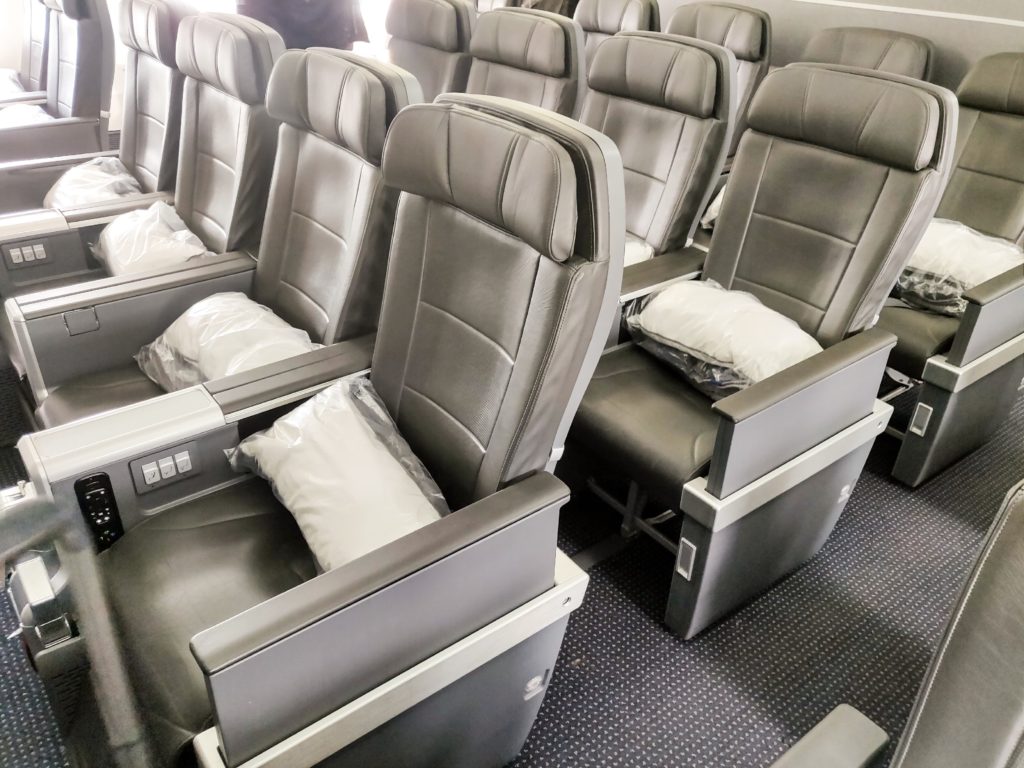
AA Premium Economy Photo: Modhop
If you’re looking for a specific benchmark, Virgin Atlantic’s Premium Economy is worth using as your comparison point — dedicated check-in, generous seat recline, upgraded meals served with real glassware, and noise-cancelling headphones.
The “Modhop Split”: Mastering the Art of the Half-Luxury Trip
One of our favorite affordable luxury travel hacks is The Modhop Split: book Economy outbound, then book Business (or Premium Economy) on the return. Most people assume they have to pick one cabin for the whole round trip. You don’t.
On the way out, you’re usually fueled by adrenaline and caffeine. You’re excited to get to your destination. This is when you fly Economy. You’re going to be awake anyway, watching three movies and drinking tiny cans of ginger ale. Save the cash here. My take: Don’t schedule any meetings for me. I like to get there and sleep in a real bed.
On the way back, though, the “vacation blues” are real. You’re tired, you’re dreading your inbox, and you probably have work the next morning. This is when you splurge on Business Class or a lie-flat seat. Booking a mixed-cabin itinerary lets you put the luxury where it actually matters (sleep), often cutting your premium spend by 30–50%, depending on the route and carrier. Or if you’re me, just stay awake and enjoy the service.
How to book: To book this, use the “Multi-City” search tool on Google Flights (or even KAYAK). Select Economy for your outbound flight and Business or Premium Economy for the return. This “unbundled” approach means you’re only paying premium prices when you’re actually going to feel the difference.
Jake, taking his planning seriously. Photo: Modhop
Splurge Math: The Price-Per-Hour (PPH) Formula
When evaluating an upgrade, stop looking at the total price. Start looking at Price-Per-Hour (PPH): the net cost of an upgrade divided by the hours you’ll actually use it.
Let’s say you’re offered a Club Level upgrade for $75 a night. If you’re out exploring all day and only sleep in the room, that’s a bad deal. But if you’re an Occasional Splurger who’ll use the lounge for breakfast, grab snacks for the day, and do a little “happy hour” before dinner, that $75 can be a sneaky bargain.
The formula is simple: (Upgrade Cost – Value of Included Perks) / Hours of Use.
Worked example: $75 Club Level upgrade, minus $40 in breakfast and happy hour value = $35 net cost ÷ 4 hours of lounge use = $8.75 PPH. Green light.
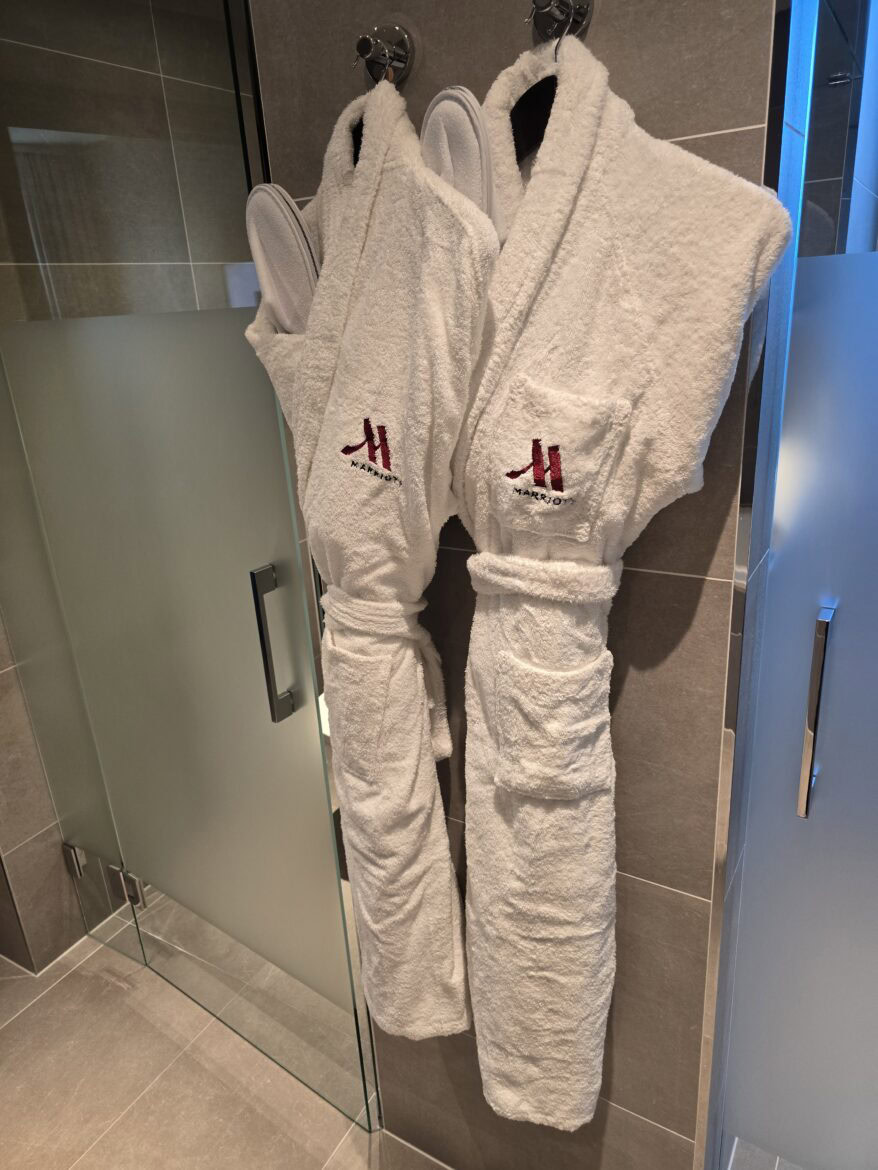
Club Level at Marriott Geneva got us Breakfast, hors d’oeuvres and cozy bathrobes. Photo: Modhop
If the PPH is less than $20 for an improved experience (better sleep, better food, less stress), it’s usually a yes. This logic applies to everything from airport lounges to hotels with a Club Level lounge where the included breakfast is worth $30+ per person.
Where to Actually Spend Your Upgrade Budget (Quick-Decision Guide)
Not all upgrades are created equal. Use this table to decide where your “splurge budget” should go.
Upgrade
Worth It If…
Skip It If…
Premium Economy (Flight)
6+ hour flight
Under 4 hours
Business Class (Return Leg)
Overnight / 8+ hours
Daytime short-haul
Hotel Club Level
You’ll use breakfast + lounge
You’re out all day
Airport Lounge Day Pass
2+ hour layover
Under 45-min connection
Exit Row / Bulkhead (Economy)
Any flight over 3 hours
You never asked for free
Domestic US First Class
Free upgrade or sub-$75 buy-up
Paid full fare on a 90-min hop
The “Basics” That Don’t Cost a Dime
While we love a good paid upgrade, some of the best affordable luxury travel hacks are free.
Join Every Loyalty Program
Join every loyalty program for every airline you fly. It sounds tedious, but as a member, you are automatically higher on the list for “operational upgrades” (when the back of the plane is full and they have to move someone up). If you aren’t in the system, you aren’t in the running.
Be the Nice Traveler
Be the “Nice Guy.” It sounds cliché, but gate agents and hotel front desk staff deal with grumpy people all day. A genuine smile and a polite inquiry, “If you happen to be looking for someone to move to that exit row, I’d love to be considered”, works significantly better than demanding status you don’t have.
Check for Last-Minute Phantom Availability
Check for “Phantom Availability” about 24 hours before your flight. We call this “Phantom Availability” — seats that were invisible or overpriced for weeks quietly reappear at a fraction of the cost once the gate count is finalized. Airlines often release unsold premium seats for a fraction of the original price right before check-in opens. This is when the $2,000 Business Class seat suddenly becomes a $400 “buy-up” offer. That’s when the Occasional Splurger strikes.
One more paid-but-often-reasonable move: the Upgrade Bid system. Carriers like Virgin Atlantic, Lufthansa, and United now offer “Upgrade Auctions” where you can bid a specific dollar amount for a better seat 48 hours before flying. It’s the ultimate gamified splurge.
Airport Intel: Your Pre-Flight Upgrade
Don’t ignore the airport experience as part of your luxury strategy. If you don’t have a lounge-access credit card, check whether your airport has a Priority Pass–affiliated lounge — many allow walk-in access for around $30–$50 (NerdWallet has a solid breakdown of lounge-access options). If a friend or travel companion has an Amex Platinum, some Centurion Lounges allow paid guest entry, though policies vary by location. Paying $50 for a quiet seat, decent Wi-Fi, and a buffet is almost always better than spending $45 on a soggy airport sandwich and a beer while sitting on the floor near a power outlet.
What NOT to Upgrade (Because Not Everything Deserves Your Money)
Not every upgrade passes the PPH test. Skip these:
Domestic US First Class on short hops — you board 10 minutes earlier and get a slightly bigger Diet Coke. Rarely worth $150+.
Premium Wi-Fi on flights under 2 hours — by the time it connects, you’re descending.
Hotel ‘upgrade’ to a higher floor with no other perks — a view doesn’t pass the PPH formula.
Priority boarding on budget carriers — you still gate-check your bag and sit in the same seat.
FAQ: Upgrading Without the Ego
Do I really need a special credit card for these hacks?
No. While cards help, most of these strategies (The 6-Hour Rule, The Modhop Split, and PPH Math) are based on cash-buy-ups and strategic booking.
Is Premium Economy just a bigger seat?
Usually, yes, but many airlines also include better food, noise-canceling headphones, and priority boarding. On some carriers, it’s closer to “Business Class Lite” than “Economy Plus.”
When is the best time to ask for a hotel upgrade?
During check-in, but ideally between 2 PM and 4 PM. This is after the morning rush has checked out and the staff knows exactly which premium rooms are still unbooked for the night.
Can I use points to upgrade if I didn’t book with points?
Generally, yes. Most airlines allow “Mileage Upgrades” on cash fares, often with a miles + cash structure (e.g., a certain number of miles plus a carrier co-pay — check your airline’s upgrade awards page for current pricing).
Can you get a flight upgrade without airline status?
Yes, it’s just less “automatic” and more “you have to go shopping.” Your best bets are (1) post-booking cash buy-up offers in the app/web check-in flow, (2) same-day upgrade lists that sometimes allow paid priority, and (3) upgrade auctions/bids where available. In other words: no status required, but you do need to be paying attention.
Is it cheaper to book Premium Economy at the airport?
Sometimes, but it’s not a guaranteed “secret menu.” You might see a cheaper same-day buy-up at check-in or at the gate if the airline is trying to clear inventory. The downside: you’re gambling on availability, and if the cabin sells out (which is happening more often), you’re stuck in economy with your knees and your regrets.
Join the Conversation
What’s your “Golden Rule” for deciding when to splurge on a travel upgrade? Do you swear by the 6-hour rule, or are you an “Economy till I die” traveler who saves it all for the hotel? Share your favorite affordable luxury travel hacks in the comments below: we’d love to hear how you game the system.
Modhop Host & Founder Jake Redman brings years of global exploration and travel tips to the podcast and our videos at Modhop. Jake is also a Producer and Host for SiriusXM.
Quick Answer Is hotel breakfast worth it? Usually, the answer is no. Unless it’s included in your room rate or you’re paying for a world-class view, you’re often paying a […]
















Post comments
This post currently has no comments.