
Hidden Airline Fees Never Really Left: How to See the Real Fare Before You Book
Why don’t airlines show their fees before you book? As of July 2, 2026, they’re not required to display bag and change fees up front, and a short-lived rule meant […]


 play_arrow
Anthony’s Philippines: “It was an Adventure” Jake Redman
 play_arrow
Anthony’s Amazing Singapore: “Toe Dipping” Point of SE Asia Jake Redman
 play_arrow
Anthony’s Ireland: Hellman’s Makes Ketchup Too Jake Redman
 play_arrow
Dallas, Disney and Deals. Our 100th Episode. Jake Redman
 play_arrow
AirBnB Cancels Some Cancelling & Jake Thinks Charlotte is a Beach Town Jake Redman
Is business class worth it on a 6-hour flight? On paper the math is clear: a $490 delta over 6.25 hours works out to about $78 per hour (Situational on the Splurge Math scale). But a six-hour flight crosses a threshold where comfort turns into a decompression decision. Verdict: Worth It Sometimes.
Jake Redman has published 207 first-hand airplane seat reviews since 2008 and has flown these transcon routes at every level of airline status, from top-tier (Platinum on both Delta and United) to no status at all.
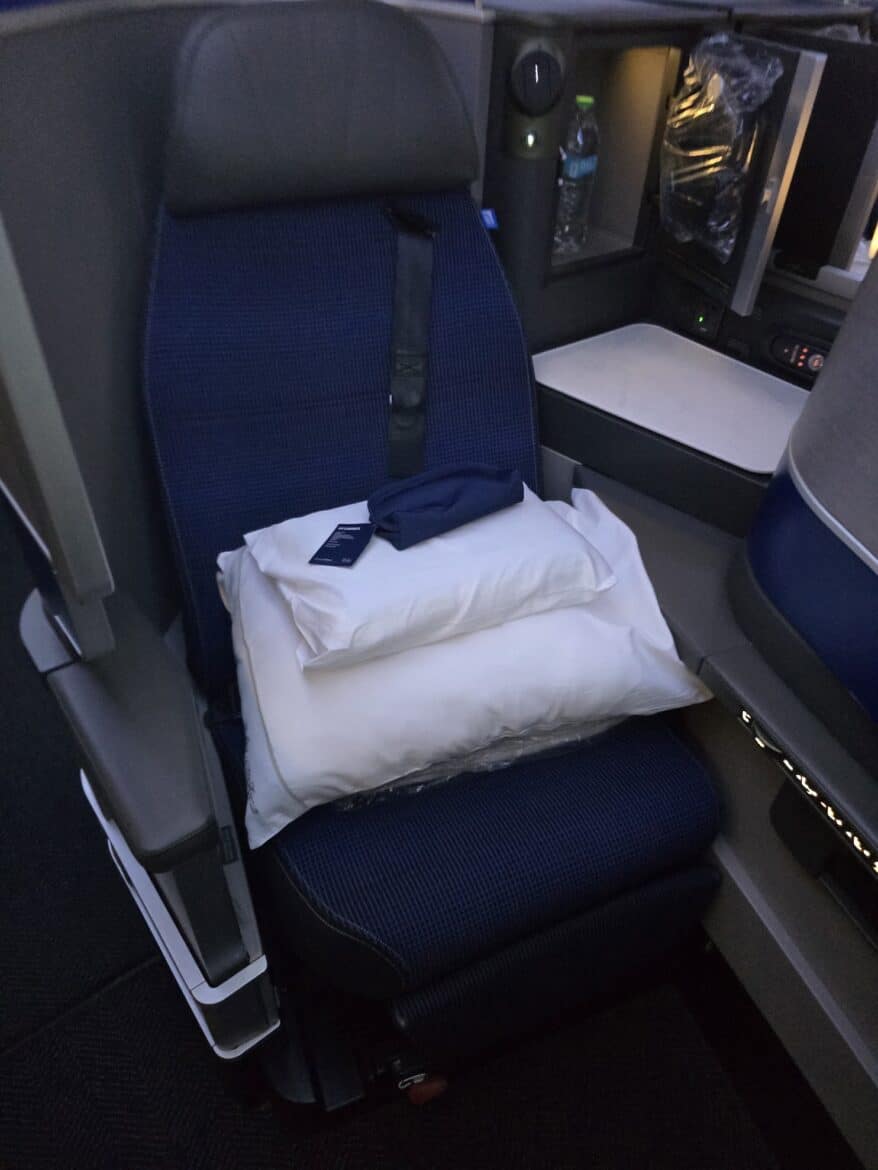
Most travel calculators treat coast-to-coast flights like a spreadsheet exercise. They take the ticket price difference, divide by the block time, and tell you to hoard your miles. But anyone who has flown economy across the continent knows the physical toll of sitting bolt upright for six hours against a stubborn jetstream. You step off the plane feeling like you survived a minor car accident. That changes the equation entirely.
Splurge Math is about buying back your sanity without feeling foolish about the cost.
Look at my recent daytime run from Newark to Los Angeles. My economy base ticket cost $193.40. I put in a waitlist upgrade request for a lie-flat Polaris seat, clearing at $250 plus 20,000 MileagePlus miles. Valuing those miles conservatively at 1.2 cents each, the total upgrade delta came to $490. Spread across a 6.25-hour block time, that works out to roughly $78 per hour.
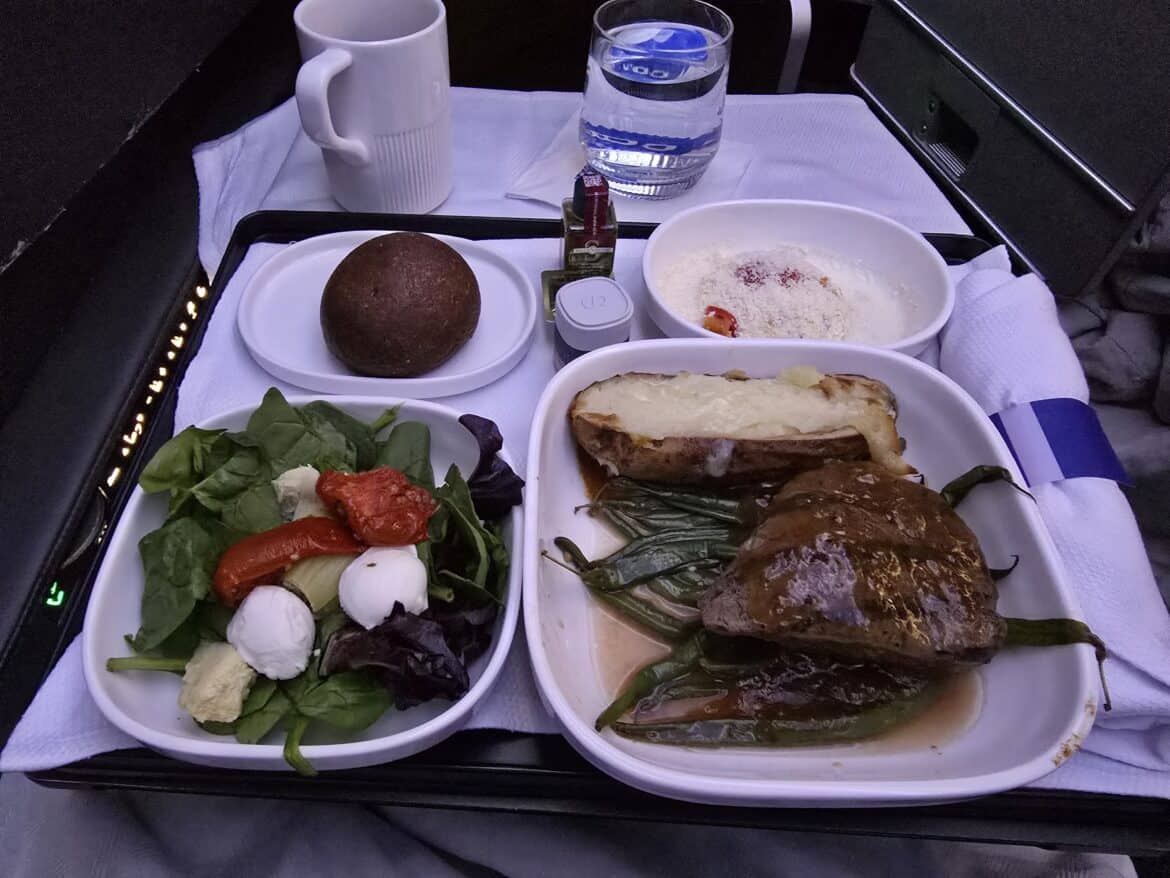
Is it cheap? No. But flying solo against the jetstream on an afternoon departure, six hours of uninterrupted, stress-free time where email and life simply couldn’t reach me made it worth it that day. Plus, the soft product delivered: solid food and a proper sundae at 35,000 feet.
Time of day completely alters what you are actually buying. Overnight red-eyes sell you the ability to wake up in California without a stiff neck, yet many travelers pay the exact same business class premium they do during the day. That is a trap. A $78/hour trap.
If you fly during the day on a six-hour hop, you are paying for environment. You want an aisle seat where the beverage cart won’t clip your shoulder. But if you take a red-eye, horizontal space becomes the entire product.
And yet, red-eyes on domestic transcon routes are notoriously short. Personally, I hate them. By the time the crew finishes dinner and dims the cabin, you might get three hours of actual horizontal sleep. Then the breakfast basket comes rattling down the aisle.
So the daytime flight often wins on actual utility. For the cost. You get the hours to work, read, or stare out the window in peace.
The biggest shock for occasional upgraders is discovering that “business class” on a six-hour flight doesn’t always mean a bed. Some airlines still operate domestic recliners on key routes, offering nothing more than extra legroom and a slightly wider cushion. Paying hundreds of dollars for a glorified rocking chair is a waste of cash.
What I flew wasn’t generic domestic first class. It was United’s transcon Polaris, a separately branded lie-flat product on the premium Newark to LAX and SFO runs. Think international business cabin, not the recliner up front on a regular domestic hop. The branding does its best to blur that line, and the price follows the better product.
You need to check the aircraft tail before you bid or burn miles. United is transitioning its fleet and phasing out older transcon airframes like the 757-200, making way for newer aircraft featuring the A321neo Coastliner with true lie-flat Polaris suites and all-aisle access.
United isn’t alone in running a real lie-flat product coast to coast. JetBlue Mint, Delta One, and American’s Flagship cabins all put a genuine flat bed on the New York to California runs. American is retiring its old Flagship First and shifting to Flagship Business on newer jets, so even within one airline the seat can change month to month. Check the specific product, not just the fare class.
And the label really is the trap. Alaska, for one, sells a First Class on these same transcon routes that is just a domestic recliner, not a flat bed. Same two words, completely different product.

If the seat doesn’t go horizontal, the Splurge Math completely falls apart. Paying a $490 premium to recline four extra inches is not a splurge. It is a donation to the airline. Always verify that your aircraft features a true long-haul hard product before you commit your funds.
If you want a deeper dive into how I evaluate these upgrades without overthinking every cent, take a look at my occasional upgrader framework. It helps you figure out when luxury is actually functional. That is the whole point.
**Modhop Splurge Math: $490 ÷ 6.25 hrs = $78/hr → Situational (Worth It Sometimes)**
The same logic applies on the rails. I applied this same framework to Acela first class, and the booking window mattered far more than the cabin.
That is the final verdict on the six-hour flight. On paper, $78 an hour reads like a luxury stretch. But the spreadsheet doesn’t measure the value of stepping off an airplane completely de-stressed.
Yes, if you value a rare stretch of unreachable, low-stress time. At around $78 per hour for a lie-flat seat, it turns a grueling travel day into six hours of total decompression against the jetstream.
Not always. It depends entirely on the aircraft. You must verify whether your flight uses a 757-200 with a lie-flat seat, one of the incoming A321neo Coastliner planes, or a standard domestic recliner.
It is situational. When you factor in a modest mileage valuation like 1.2 cents per point alongside a reasonable cash copay, it often beats paying the full cash business class fare outright.
Sometimes, but read the label first. A lot of what airlines sell as an upgrade on a 6-hour flight is really just an extra-legroom coach section, like United’s Economy Plus or Delta’s Comfort+, which is more room, not a different class. True premium economy, with a genuinely wider seat and elevated meal service, only shows up on some airlines and even then only on certain aircraft, so it is rare on domestic transcons. When you can actually get it, real premium economy is a solid daytime middle ground for less than business. On a red-eye, though, the lie-flat seat is still the only thing worth paying up for.
What is your personal threshold for a transcon upgrade? Do you shell out for lie-flat seats on daytime hops, or do you save your cash for red-eyes? Drop a comment below and share your own Splurge Math.

Modhop Founder Jake Redman brings years of global exploration and travel tips to the podcast and our videos at Modhop. Jake also produces audio branding for several music channels on SiriusXM.

Why don’t airlines show their fees before you book? As of July 2, 2026, they’re not required to display bag and change fees up front, and a short-lived rule meant […]




Post comments
This post currently has no comments.