If you woke up this morning feeling like your travel rewards strategy just got hit with a heavy dose of reality, you aren’t alone. It’s Monday, April 20, 2026, and the landscape of points, miles, and “standard” airline fees shifted significantly over the weekend. The “United MileagePlus changes 2026 edition” alone are enough to make any occasional upgrader rethink their loyalty stack — and that’s before we get to a major credit card devaluation that went live yesterday and significant industry-wide fee hikes that have been stacking up this month. Whether you are a digital nomad trying to keep your overhead low or an occasional upgrader looking for that sweet spot in the clouds, this week’s intel is going to require some pivots.
Airport Intel: The India-North America Corridor Gets Smoother
Let’s start with some actually good news so we can start off happy-ish. Air India and WestJet have officially kicked off their new interline partnership agreement, and it is a massive win for anyone looking for smoother travel between the Indian subcontinent and North America. By utilizing major hubs like Toronto (YYZ) and Vancouver (YVR), travelers can now book single-ticket journeys to over 30 destinations across Canada and the United States.
For the digital nomad crowd, this is big. Managing separate tickets through major hubs is always a gamble, especially with the current state of global flight delays. This partnership streamlines the “India-North America corridor,” allowing for easier baggage transfers and better protection if a connection goes sideways. If you’ve ever tried to self-connect in Vancouver after a long-haul flight from Delhi, you know exactly why this matters. If you find yourself passing through Vancouver’s USA gates during one of these new connections, you might want to check out our look at the Plaza Premium Lounge to see if it’s worth your layover time.
United MileagePlus Changes 2026: The “Cardholder Season” Shakeup
United Airlines decided to pull the curtain back on a massive MileagePlus overhaul earlier this month, with changes taking effect on April 2, and the message is loud and clear: if you don’t have their credit card, you’re essentially a second-class citizen in their loyalty ecosystem. You could call it “Cardholder Season” because the disparity between “haves” and “have-nots” has never been wider.
For general members who don’t hold a co-branded United credit card, the earning rates have taken a nosedive, dropping as low as 3x miles per dollar. However, if you have any United card in your wallet, even the entry-level ones, that rate jumps back up to 6x. Higher-tier cards like the Quest and Explorer saw even more aggressive multiplier bumps, although the United Gateway Card and the MileagePlus Debit Rewards Card each require $10,000 in annual spend to unlock the cardholder earn rate. United is essentially placing a “loyalty tax” on anyone who isn’t willing to pay an annual fee to Chase. This changes the travel rewards strategy for the occasional upgrader significantly. If you aren’t flying United enough to justify the card, your path to a “free” flight just got twice as long.
Splurge Math: United Explorer Card
The United Explorer Card has a $95 annual fee, which sounds annoying until you run the math. Spending $1,500 per year earns 4,500 extra miles, which we’d peg at roughly $54 in value. Add in the current $90 round-trip checked bag savings, and you’re basically at break-even if you’re a twice-a-year flyer. Not exactly glamorous, but sometimes boring math is the most useful math.

While you’re weighing the cost of that annual fee, you might be looking at the actual on-board experience to see if the loyalty is worth it. We recently took a look at the United Economy Plus 737-900 to see if that extra legroom actually delivers on the promise of “affordable luxury.”
Points Intel: Mourning the Citi-to-Choice 1:2 Ratio
Yesterday, April 19, was a bit of a dark day for many points optimizers. The long-feared Citi ThankYou transfer devaluation to Choice Privileges finally took effect. For years, the 1:2 transfer ratio was a “secret menu” of sorts for getting often incredible value out of Citi points. By moving points to Choice, you could then book “Preferred Hotels & Resorts” properties for a fraction of the usual cost, like an ultimate low-cost luxury play.
As of yesterday, that ratio has dropped to 1:1.5. A 25% drop might not sound like a total dealbreaker, but in the world of high-end redemptions, it’s a gut punch. For example, a hotel that previously required 25,000 Citi points now effectively costs over 33,000. It’s a reminder that “earn and burn” is always the safest travel rewards strategy. Sitting on a mountain of points is just waiting for a bank to tell you they’re worth less than they were yesterday. For a full breakdown of the transfer ratio changes, Frequent Miler has the details.
There’s also a separate devaluation worth flagging if you keep a hotel transfer spreadsheet, an admittedly annoying new norm among points optimizers. Citi’s transfer ratio to I Prefer Rewards dropped from 1:4 to 1:2 on April 19. That is a much uglier haircut than the usual “minor adjustment” language these programs like to hide behind, and it meaningfully weakens one more niche sweet spot for travelers who liked turning flexible points into boutique hotel stays.
If you’re looking for other ways to find “affordable luxury” without relying on devalued transfer partners, our guide on travel tips might be helpful.
Even More Airport Intel: Delta’s Bag Fee Blues
If you’re flying Delta anytime soon, prepare for your wallet to be a little lighter before you even clear security. Delta hiked bag fees on April 8, and you’re now looking at $45 for your first checked bag and $55 for your second. That puts the round-trip savings from avoiding just the first bag fee at $90, which is a pretty efficient way for Delta to remind everyone that “basic” air travel is doing a lot of heavy lifting these days.
The macro backdrop here matters too. Airlines have been dealing with a major jet fuel spike, with prices up roughly 88% after the Strait of Hormuz closure, so fee hikes were probably more of a “when” than an “if.” Still, this is also a blatant nudge to get more people to either carry-on their luggage or, stop us if you’ve heard this before, sign up for a co-branded credit card. Most Delta Amex cards still offer a first bag free, which now has a value of $90 round-trip. It’s (sadly) getting harder to justify traveling without these cards if you fly even twice a year. If you’re looking to avoid the fees and stick to a carry-on, you’ll want to make sure your seat is comfortable enough to justify the hassle. We’ve got a deep dive into Delta’s Economy Comfort on the A330 that gives you an example of what you’d get for your effort.

Travel Intel: Amex Platinum’s Domestic Pivot
In a surprising twist, American Express is expanding Platinum Member Airfares to include domestic economy flights. Historically, this perk was the playground of the business and first-class international traveler, offering discounts on premium cabins. Now, Platinum cardholders can also find select domestic economy pricing in the mix.
It’s a nice little add-on for those “coach flyers” who still hold the Platinum card for the lounge access and hotel status. Speaking of lounges, there is a looming deadline you need to mark on your calendar: Amex’s partnership for Lufthansa lounge access is officially ending on October 1. If you enjoyed that pre-flight schnitzel in Frankfurt or Munich, you’ve only got a few months left to soak it in. If you find yourself losing access and needing a new home base, you might want to see how the Swissport Lounge in Chicago stacks up as an alternative.
Featured Reading
While we are talking about upgrades and airline shifts, we have two deep dives you shouldn’t miss this week. First, check out our report on the Delta A330 Retrofit. It’s the primary target for the occasional upgrader looking to see if the new cabin interiors live up to the hype.
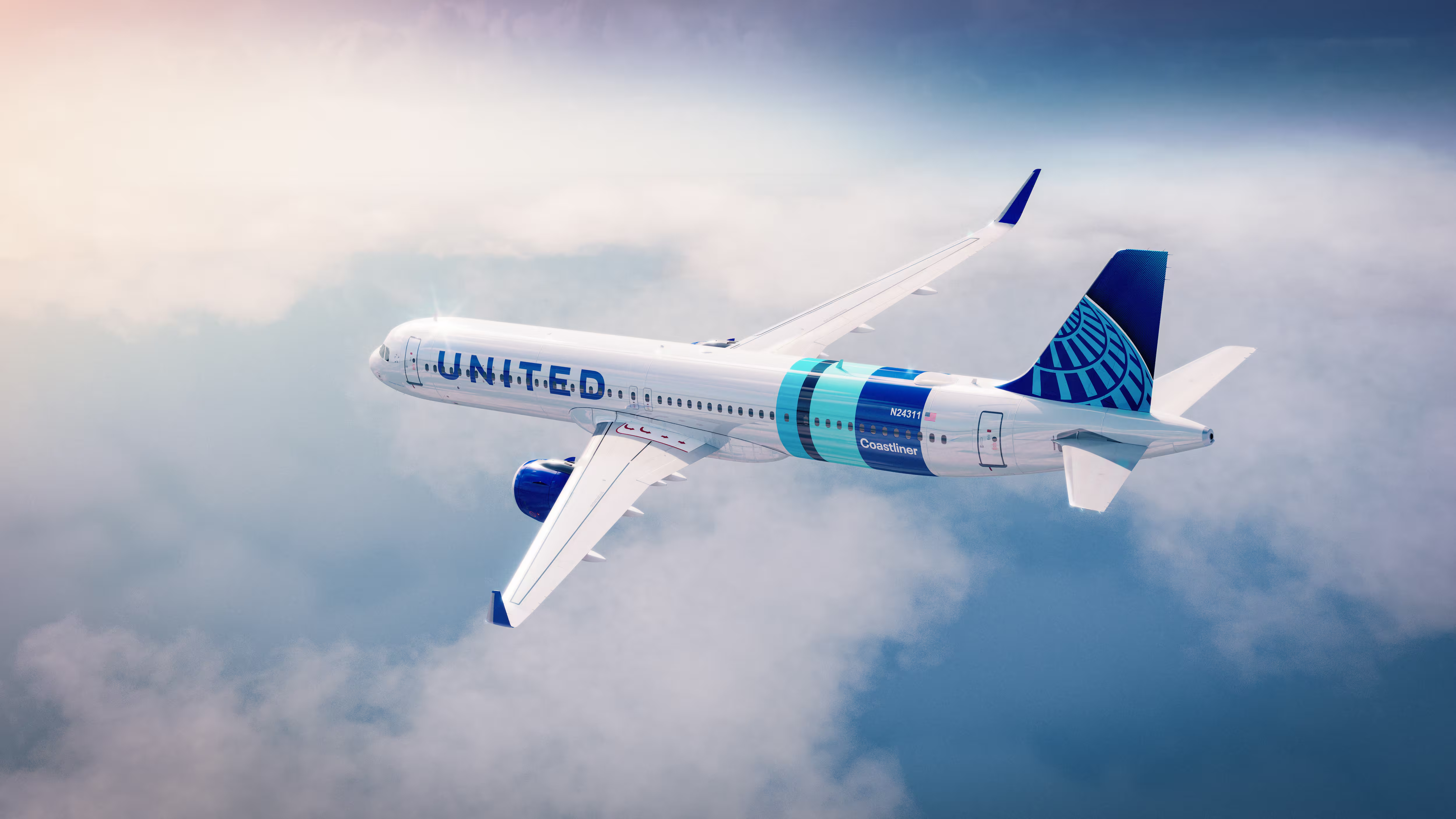
Second, for those of you flying across the US, we tackle the big question: Is the transcon upgrade worth it? Read our breakdown of the United Coastliner Premium Plus (spoiler: if you’re over six feet tall, the answer is almost always yes).
Hotel Intel: The Modhop Tip — The Marriott ‘Top-Off’ Strategy
We have one more strategy tip that many people overlook. Don’t let your Marriott Free Night Awards gather dust because you think you can’t afford the “fancy” hotels.
Marriott now allows you to “top off” your certificates with up to 25,000 points from your account — an increase from the old 15,000-point cap that quietly went into effect on March 12. If you have a 50,000-point certificate from a credit card, you can now book a room that costs up to 75,000 points. That’s the difference between a solid Westin and a legitimate shot at a Ritz-Carlton or St. Regis on a lighter-demand night. Instead of burning that certificate on a Courtyard by the airport (nothing personal, Courtyard), save it, top it off, and spend a night somewhere worth the story. You’ve earned the points — don’t be afraid to spend a few extra to unlock a much better experience. If you need inspiration, the Hollywood Roosevelt is a good place to start.
Final Airline Intel (for now): The Modhop Tip: The United P.S. Legacy Tip
We’re wrapping up this week with a strategy tip for anyone who still remembers when United p.s. actually meant something very specific. Before Coastliner started becoming the new transcon headline, United’s old p.s. product was the legacy premium-service configuration used on select transcontinental routes, with a noticeably more premium setup than your standard domestic narrow-body.
That distinction still matters because a lot of travelers see “premium transcon” language and assume it all points to the same onboard experience. It doesn’t. United p.s. was the old-school premium configuration; Coastliner is the newer push to bring Premium Plus onto narrow-body aircraft in a more scalable way. Similar idea on paper, different aircraft setup, different vibe, and definitely different expectations once you sit down. In other words, don’t book based on nostalgia and then act shocked when the seat map tells a different story.
FAQ
What changed with United MileagePlus on April 2, 2026?
Earlier this month, United rolled out new MileagePlus earning rules that heavily favor cardholders. General members can earn as little as 3x miles per dollar, while cardholders can earn higher rates depending on the card, and some cards now require specific annual spend to unlock better earning.
What happened with Citi and I Prefer on April 19, 2026?
On April 19, Citi reduced its transfer ratio to I Prefer Rewards from 1:4 to 1:2. That’s a sharp devaluation for travelers who used Citi points for boutique and independent hotel redemptions.
When did Delta’s new bag fees start, and what are they now?
Delta’s updated bag fees started April 8. The first checked bag now costs $45, and the second costs $55, making the round-trip savings from avoiding the first bag fee $90.
What’s the difference between United p.s. and Coastliner?
United p.s. refers to the airline’s legacy premium-service transcon configuration. Coastliner is United’s newer narrow-body strategy that brings Premium Plus to single-aisle aircraft. They’re related in the sense that both target premium domestic travelers, but they’re not the same product.
What is the new Citi ThankYou to Choice Privileges transfer ratio?
As of April 19, 2026, the ratio dropped from 1:2 to 1:1.5. You now receive 1,500 Choice Privileges points per 1,000 Citi ThankYou points transferred, down from 2,000.
When does Amex Platinum Lufthansa lounge access end?
American Express Platinum and Business Platinum cardholders lose complimentary Lufthansa lounge access as of October 1, 2026.
Join the Conversation
The travel landscape is changing fast, and “Cardholder Season” seems to be the theme of 2026. Does the United MileagePlus shakeup make you want to grab a credit card, or does it make you want to jump ship to a different airline entirely? And for the points pros out there: how are you pivoting after the Citi devaluation? Share your new travel rewards strategy in the comments below!
Tagged as: points and miles, Platinum Member Airfares, weekly modhop, interline partnership, travel loyalty news, Lufthansa lounge access, occasional upgrader, Air India, United MileagePlus, Delta bag fees, Choice Privileges, Marriott free night, MileagePlus changes 2026, Marriott top off, Citi ThankYou, earn and burn, WestJet, I Prefer Rewards, travel rewards strategy, united explorer card, Delta checked baggage, cardholder season, amex platinum, Citi devaluation, United Gateway Card.














Post comments
This post currently has no comments.